
Information for authors
Stichproben Article Templates
The following downloads provide templates for articles for the journal Stichproben in LibreOffice and Microsoft Office, featuring standardised style sheets as well as automated headers, page numbering, figure and table numbering, and cross-references. The use of these style sheets and fields ensures a smooth editing, layout and publication process. Furthermore, this guarantees that the articles comply with accessibility standards.
Four template files: two .ott files (LibreOffice Writer templates) and two .dotx files (MS Word templates).
The LibreOffice Writer templates also work in other open-source office suites such as OpenOffice, Zeta-Office, Collabora or WPS Office.
The sp-template_example templates serve to provide (visual) examples of the style sheets used in the template. The sp-template_use files are the templates to be used by authors. However, the sp-template_example files may also be used.
All four templates use the same paragraph styles and can be opened in both MS Word and LibreOffice Writer (and its derivatives). The only difference is the font: the LibreOffice Writer templates use Liberation Serif, whilst the MS Word templates use Times New Roman, as MS Office does not include any open-source fonts by default. The two fonts are visually identical. If you are using Apple macOS Pages, only the MS Office templates (.dotx) will work.
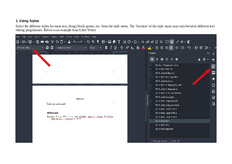
For detailed instructions on how to use the template, please read the Readme file and the Style Tutorial.
Thank you very much for using the templates!
Supported Programs
- LibreOffice Writer 7.x + (and derivates) (Linux, Microsoft Windows, Apple macOS)
- Microsoft Word 2010–365 (Microsoft Windows, Apple macOS)
- Apple Pages (Apple macOS)
Downloads

Submission Process
1. Submission of a manuscript to the editorial team for the peer-review process
An abstract must be attached to the manuscript. The abstract should clearly set out the paper’s research question, main arguments and methods. Please send the manuscript, including the abstract per mail to the editorial team or to the relevant issue editors, ensuring that it complies with the formatting guidelines (see the information on the website).
2. Acceptance/rejection of the manuscript by the editorial team
The manuscript is reviewed anonymously by internal and external reviewers as part of a peer-review process. The reviews are subsequently evaluated by the editorial team and form the basis for the decision on whether to accept a contribution. This process usually takes around one month. If the article is provisionally accepted, the feedback will include details of any required or suggested changes and a new deadline for submitting the second draft. This will be discussed once more within the editorial team.
3. Rejection of submissions
The editorial team reserves the right to reject submissions that do not conform to the journal’s editorial policy or standards. Submissions which, in the editorial team’s view, have not been brought up to a print-ready standard by the end of the second deadline may also be rejected.
4. Review copies
Authors will receive three printed review copies.
Guidelines for Authors
-
Citation style in the main text
References to published works in the text:
Single author:
(Surname Year: Page), e.g. (Odhiambo 2011: 2)Two authors:
(Surname/Surname Year: page), e.g. (Odhiambo/Atieno 2012: 34)Where there are more than two authors:
(Surname et al. Year: page), e.g. (Odhiambo et al. 2013: 23)Separate multiple references with a semicolon:
(Surname1 Year: page; Surname2 Year: page), e.g. (Odhiambo 2011: 2; Atieno 2013: 23)References from the internet:
(Main website or organisation Year), e.g. (UNDP 2001); The URL and date of access must be included in the bibliographyPage references for more extensive citations:
(Surname Year: p.), e.g. (Odhiambo 2011: 2)
(Surname Year: pp.), e.g. (Odhiambo 2011: 2)References to newspapers:
“Date back to Zambia’s pre-independence days” (Times of Zambia, 9 February 1970).
For two articles on the same day: “Quote 1” (Times of Zambia, 9 February 1970a); “Quote 2” (Times of Zambia, 9 February 1970b)
References to interviews:
“Our work played a key role.” (Interview with Peter Kasoma,
Lusaka, 21 March 2016)References to archive material:
First mention: “Quote 1” (Archive of the United National Independence Party of Zambia, Endangered Archives Programme, henceforth: UNIP EAP, 121/2/12/3/10, p. 1)
Second and subsequent mentions: “Quote 2” (UNIP EAP, 121/2/12/3/10, p. 1)
-
Bibliography at the end of the article
The bibliography at the end of the article must contain all the bibliographical references cited in the article. Please check these against the references in the text before submission and list only those sources that have been used.
If primary sources (newspapers, interviews, archival sources, etc.) have been used, list these before the published works. Arrange each category chronologically, from the oldest to the most recent source. For example:
Bibliography:
A) Primary sources
Newspapers
Times of Zambia, 7 February 1970a, “Yugoslavia – a top partner in our trade”
Times of Zambia, 7 February 1970b, “Real pals—for good! Tito says friendship links will grow”
Interviews
Interview with Peter Kasoma, Lusaka, 21 March 2016
Archival sources
Archive of the United National Independence Party of Zambia, Endangered Archives Programme (UNIP EAP)
EAP121/2/12/3/10: “Party Newspapers and Times of Zambia, Correspondence [1974–1976]”, eap.bl.uk/archive-file/EAP121-2-12-3-10, Sikota Wina to Grey Zulu, 31 July 1975
B) Secondary sources (If no primary sources have been used, this section may simply be titled ‘Bibliography’ without A) and B))
Published sources must be listed in alphabetical order (by author):
Articles in edited volumes:
Surname, First name (Year): Title. In: Editor(s) (ed.): Book title. Place of publication: Publisher, page–page.
Articles in journals:
Surname, first name (year): Title. In: Journal, volume/issue, page–page.
Online sources:
Surname, first name (publication date): Title of the page or article, URL (access date).
Monographs:
Surname, first name (year): Title. Subtitle. Place: Publisher.
Collected works:
Editor’s surname, editor’s first name (ed./eds., Year): Title. Subtitle. Place: Publisher.
Multiple authors should be separated by slashes (Surname, First name/ Surname, First name).
Please do not write surnames in the bibliography entirely in capital letters. The correct version is Odhiambo (not ODHIAMBO)
Language
Submitted papers should preferably be written in German, English or French. Where appropriate, papers in Swahili may also be accepted.
Formatting guidelines
Article length: approx. 8,000 to a maximum of 10,000 words (including bibliography)
Length of the abstract: up to a maximum of 300 words
Foreign-language terms and proper names in italics
Short biography: maximum 100 words; information to include: current position, disciplinary background, main areas of research. Email contact details.
Open Access and Copyright
Stichproben adheres to an open access policy. Articles are published under the Creative Commons Attribution Licence. Long-term archiving of Stichproben is carried out via PHAIDRA at the University of Vienna.
As all articles are published under the journal’s open access policy, all authors must accept these rules upon submission. Authors may publish the published version on their personal institutional website and deposit it in their institution’s official repository, provided they reference the ‘Stichproben’ website and specify the original place of publication.
Stichproben allows authors to dispose of their copyright without restriction. Authors also retain unrestricted publication rights for their contribution.
Publication fees
The editorial team at Stichproben is committed to providing its authors with the best possible support.
We recognise that publication fees (known as Article Processing Charges, or APCs) can present a financial barrier for many authors. Therefore, authors publishing in Stichproben are fully exempt from APCs if one or more of the following criteria apply:
- institutional affiliation or permanent residence in Africa, Asia (excluding Japan, South Korea, Oman and the UAE) or South America (from Mexico southwards)
- their university or research institution does not provide funding to cover APCs
However, even for authors from the Global North, payment of APCs is only an option if open-access publishing agreements are in place for them.
If you have any questions regarding APCs, please contact the editorial board directly: stichproben.afrikanistik@univie.ac.at
If, as an author, you are eligible for funding through your institutional affiliation, we charge €1,500 per open-access research article (book reviews, interviews and all other contributions are exempt from APCs).
These fees enable us to fund professional editorial and translation services, keep our website up to date and expand our academic activities (e.g. through workshops with African researchers).
Plan S, which was launched by a consortium of national research agencies and funding bodies from twelve European countries (as well as African countries such as Zambia) and is supported by the European Union, calls on researchers to publish publicly funded research in open access and thus make it freely available to the public. A number of universities in Europe and North America (and beyond) offer authors funding opportunities for open-access publications.
If you are a member of the University of Vienna and are acting as the ‘corresponding author’, we are pleased to inform you that you can submit an application for full funding of APCs to the University of Vienna’s Open Access Office. The online form contains only a few fields and can be completed in two minutes. Should you nevertheless have any questions, the two editors of the selected journals will be happy to assist and guide you through the application process.
Open access publication funding and support
We would also like to draw attention to the following institutional services that support or fund open access publishing. Depending on the institution, these may include publication funds, agreements with publishers or specialist advice. Eligibility requirements and the availability of funds should always be checked directly with the relevant institution; full coverage of article processing charges (APCs) cannot be guaranteed.
Austria
- University of Innsbruck — Publication fund
- University of Graz — Publication fund
- Johannes Kepler University Linz — Publication fund
- BOKU University, Vienna — Publisher agreements / publication support
Germany
- University of Bayreuth — Publication fund
- Humboldt University of Berlin — Publication fund
- Freie Universität Berlin — Publication fund
The Netherlands
- Leiden University — Funding guidance / advice
Switzerland
- University of Basel — Publication fund
United Kingdom
- SOAS, University of London — Publisher agreements / publication support
- University of Cambridge — Publisher agreements / publication support
Further information
- Austrian Academic Library Consortium (KEMÖ) – Open Access agreements and contacts
- open-access.network – guidance on journal funding models
Links checked: 9 October 2026